2026-04-02
Internal arc faults in low-voltage switchgear are rare but can cause severe damage. When an arc occurs due to insulation failure, foreign objects, or operational errors, temperatures can reach 20,000°C within milliseconds, and pressure can rise to tens of thousands of Newtons per square meter. Without proper protection, hot plasma and molten metal may escape the enclosure, endangering nearby equipment and personnel.
UL 891 provides key requirements for internal arc fault protection. This article explores how structural design—covering fault mechanisms, protection principles, design requirements, and modern technologies—can deliver effective protection.
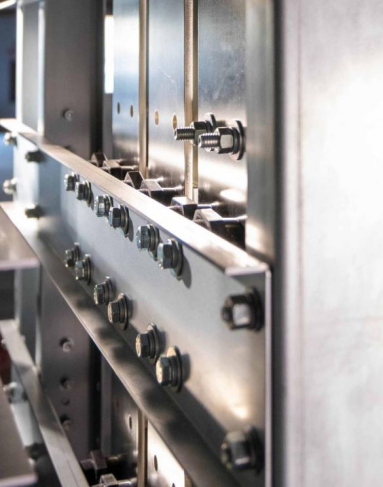
An internal arc fault refers to an unintended arc discharge inside switchgear caused by insulation breakdown between live conductors or between a conductor and ground. Unlike switching arcs generated during normal operation, internal arc faults are characterized by their uncontrollable nature and high energy density.
Taking a typical industrial power distribution system as an example, the energy released by a 20kA arc fault lasting 100ms can be estimated using the following formula:
Energy (Joules) = Current × Arc Voltage × Duration
Based on an arc voltage of 500V:
20,000A × 500V × 0.1s = 1,000,000 Joules
This is equivalent to the energy of approximately 250 grams of TNT explosives being released instantaneously within a confined space.
| Effect Type | Parameter Range | Impact |
|---|---|---|
| Thermal Radiation | 10,000–20,000°C | Metal melting, cable insulation carbonization, personnel burns |
| Pressure Shock | Several kPa to tens of kPa | Structural damage to enclosure, door detachment, debris projection |
| Acoustic Shock | Above 160 dB | Permanent hearing impairment |
| Toxic Gases | Metal vapor, ozone, decomposed gases | Inhalation injury, risk of asphyxiation |
UL 891 adopts a design principle combining isolation and pressure relief for internal arc fault protection.
UL 891 requires switchgear to be divided into independent compartments using grounded metal barriers. Typical partitioning includes:
Bus Compartment: Space housing main and branch buses
Breaker Compartment: Space for circuit breaker functional units
Cable Compartment: Space for incoming and outgoing cable connections
Low-Voltage Compartment: Space for control, metering, and protection components
Metal barriers at least 2.0mm thick physically separate compartments, confining an arc fault to its origin and preventing it from spreading to adjacent areas.
Each compartment is equipped with a pressure relief device at the top or rear. When an arc fault occurs inside a compartment, the high temperature causes rapid air expansion and a sharp pressure increase. The pressure relief device automatically activates upon reaching a set threshold (typically 10–20 kPa), directing high-temperature, high-pressure gases to a safe area behind or above the enclosure for discharge.
Types of pressure relief devices include:
| Type | Operating Principle | Application Scenario |
|---|---|---|
| Mechanical Hinged Cover | Pressure pushes open a hinged cover plate | Conventional industrial distribution, reusable |
| Bursting Disc | Pressure ruptures a preset weak point | Applications requiring fast response, single-use |
The opening direction of the pressure relief device must not face the operating front, a basic safety requirement of UL 891.
The barriers and enclosure structure must withstand the mechanical stress generated by an arc fault. Key design considerations include:
Barrier material thickness not less than 2.5mm
Door locking mechanisms capable of withstanding internal pressure impacts
Bus support spacing meeting short-circuit electrodynamic force withstand requirements

In addition to passive structural protection, modern switchgear can be equipped with an arc flash protection system to achieve early fault detection and rapid fault clearing.
The arc flash protection system consists of arc sensors, a protection device, and a high-speed circuit breaker:
Arc Sensors: Continuously monitor light intensity inside the enclosure and detect characteristic spectra of arcs.
Protection Device: Receives sensor signals while monitoring current changes, confirms arc fault identification, and issues a trip command.
High-Speed Circuit Breaker: Rapidly interrupts the fault current upon receiving the command.
| Protection Method | Typical Response Time | Proportion of Energy Released |
|---|---|---|
| Traditional Circuit Breaker Protection | 80–120 ms | 80–100% |
| Arc Flash Protection System | <15 ms | <10% |
By clearing the fault within 15 ms, the arc energy is insufficient to form destructive pressure and temperature, significantly reducing equipment damage and ensuring personnel safety.
The arc flash protection system does not replace the structural protection requirements of UL 891. The relationship between the two is as follows:
Passive Protection (compartmentalization + pressure relief): Provides physical barriers to ensure that even if a fault occurs, hazards are contained within a defined range
Active Protection (arc flash protection): Clears the fault as early as possible to reduce energy release and damage
The optimal design combines both approaches to form a dual-layer protection system.
Based on UL 891 requirements, switchgear designed with internal arc fault protection capabilities should meet the following key points:
| Design Element | Specific Requirement |
|---|---|
| Compartment Division | Bus, breaker, cable, and low-voltage compartments independently isolated |
| Barrier Thickness | ≥2.5 mm metal plate |
| Pressure Relief | Independent device for each compartment; opening not facing operating front |
| Bus Support | Spacing meets short-circuit electrodynamic force withstand requirements |
| Cable Entry | Sealed with bushings where passing between compartments |
| Door Locking Mechanism | Capable of withstanding internal pressure impacts |
Internal arc faults are a critical risk in low-voltage switchgear. UL 891 provides foundational passive protection through compartmentalization and pressure relief requirements. Adding an arc flash protection system further enhances safety by enabling early fault detection and rapid clearing.
For critical power distribution, selecting switchgear with internal arc fault protection is essential to ensure personnel safety and reliable operation.
Recommended Products

Your one-stop supplier for energy management solutions.
Products
Contact Us
720 Yuandong Road, Fengxian District, Shanghai, China
+86-19101772387
+86-19101772387
info@infraswin.com

 English
 中文简体
中文简体
 Español