From the CIIF Show Floor to Smart Inspection in the Distribution Room: Taking Intelligent O&M a Step Further
2026-10-20
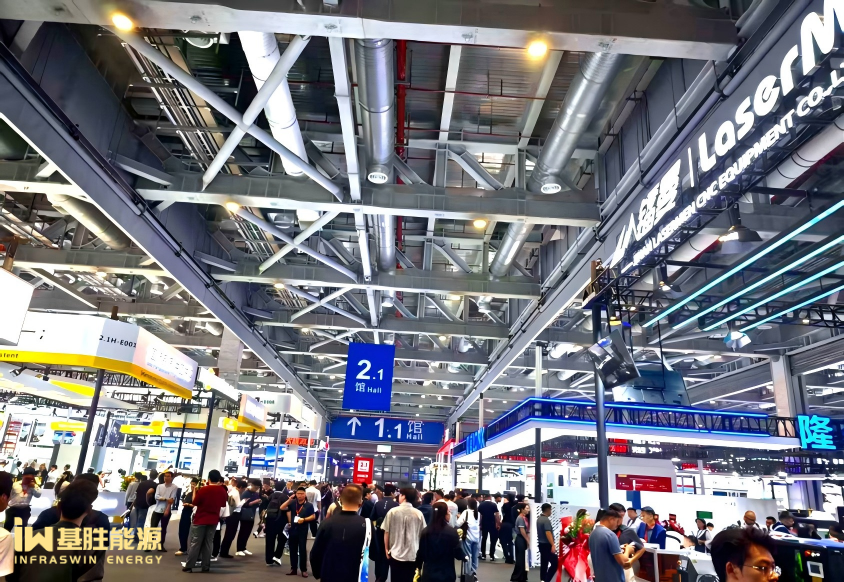

October in Shanghai once again put industrial innovation in the spotlight. The 2026 China International Industry Fair (CIIF) was held at the National Exhibition and Convention Center (Shanghai) from October 12 to 16, presenting how industrial technologies and real application scenarios come together around intelligence, green development and integration.
From the wide range of industrial equipment on the show floor to the power supply and distribution facilities that enterprises rely on every day, the value of intelligent technology ultimately has to be proven in real applications. We therefore focus on one specific scenario: when an inspection robot enters a 10 kV distribution room, what actually changes for power supply and distribution O&M?
For Infraswin Energy, this is also an important starting point for thinking, from the customer's real needs, about how power supply and distribution systems can further improve operational reliability and O&M efficiency.
01 Starting with Repetitive Patrols: Making Everyday O&M More Efficient
A 10 kV distribution room links the upstream power source with the enterprise's electricity system, and its operating condition affects the supply to production, offices and various critical loads. In daily O&M, staff have to check meter readings one by one, review equipment status, look for temperature changes, and then compile and file the inspection results. As equipment volumes grow and sites spread out, this repetitive work takes up more and more time and places higher demands on the completeness and consistency of records. Inspection robots offer a new way to handle this work. Following preconfigured routes, points and tasks, a robot can collect images, read meters and check status, then upload the results to a management platform to form searchable inspection records. Existing technical solutions for distribution room inspection integrate visible-light, infrared and partial discharge detection into the robot, providing support for equipment patrols.
Making repetitive checks more standardized, and freeing O&M staff to put more energy into anomaly analysis and equipment maintenance — that is the first value smart inspection can deliver.
02 Focusing on Equipment Condition: Making Anomalies Easier to Detect
In a 10 kV distribution room, the priority is to keep track of equipment condition and to identify changes that deserve a closer look. Using visible-light cameras and image recognition, the robot can help read panel meters, identify indicator lights and position indicators, and keep on-site images so that O&M staff can review them remotely.
Using infrared thermal imaging, the robot can measure the temperature of equipment surfaces or of targets visible through inspection windows, helping to monitor local temperature rise and temperature trends. For areas concealed inside metal-enclosed cabinets, supplementary monitoring such as fixed temperature sensors is required.
Depending on equipment type and site requirements, partial discharge, acoustic or environmental detection modules can also be configured to provide more information for troubleshooting. The specific detection capability has to match the sensor configuration, installation position and site conditions. Inspection data collected on the same equipment at different times therefore also provides a basis for continuous comparison. If, for example, the temperature at a measurement point rises gradually, O&M staff can assess it together with load, ambient temperature and historical records to decide whether further inspection is needed.
Every inspection leaves data that can serve as a reference for the next judgment.
03 From Detection to Resolution: Making Inspection Results Truly Count
Once an anomaly is detected, how the information is passed to the right people in good time is the key to whether smart inspection delivers value.
Take a temperature anomaly as an example. A sound process would be: the robot collects the abnormal data; the platform links the equipment ID, detection time, visible-light photo and thermal image, and alerts the O&M staff; after review, the staff arrange an inspection or maintenance task based on how the equipment is running; once the work is done, a repeat measurement confirms the result and the case is filed. This process gives every alarm an on-site basis, a handling record and a follow-up verification.
At present, the Infraswin Energy digital cloud inspection platform already supports task management, real-time monitoring, anomaly tracking and inspection reports, and can connect with other management systems where interfaces permit, supporting centralized O&M.
For enterprises with multiple distribution rooms, this means O&M staff can view inspection status in a more centralized way and focus their attention first on the equipment and sites that need to be handled.
The robot takes on data collection and assisted recognition, while specialists make the judgments and take action; together they improve both the efficiency and the quality of O&M work.
04 Grounded in Site Conditions: Making Smart Inspection Truly Work
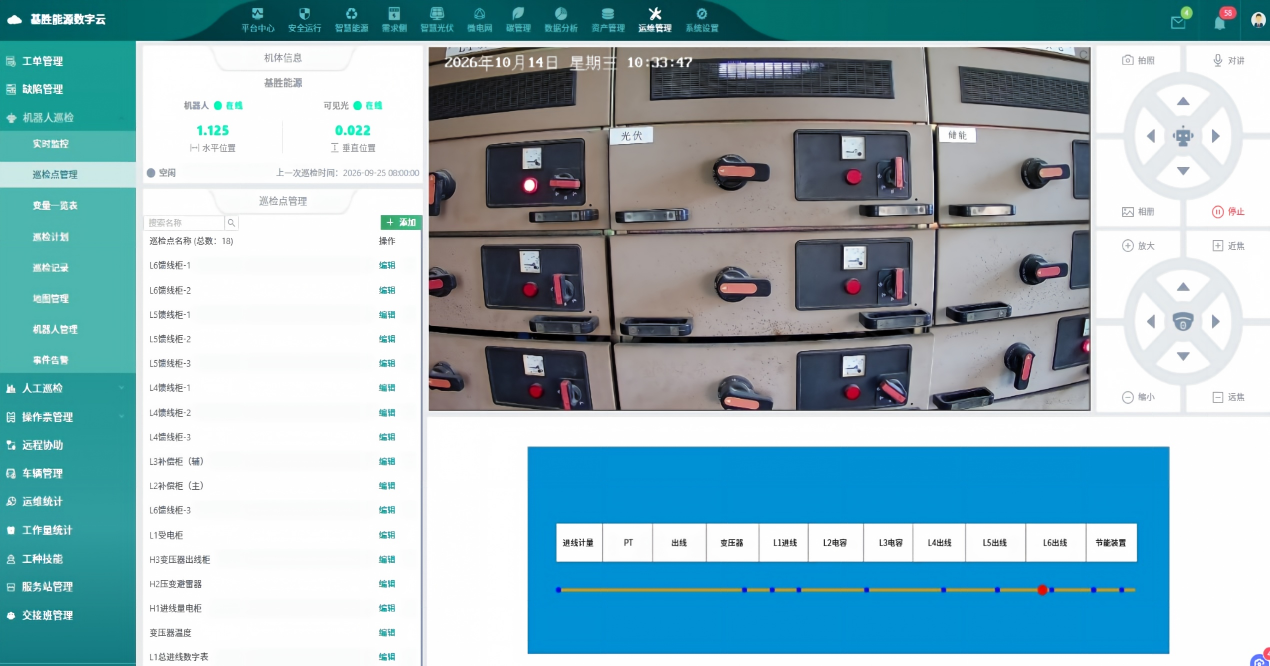

Distribution rooms differ in spatial layout, cabinet structure and access conditions, so smart inspection has to start from the site itself.
For scenarios with relatively fixed routes, a rail-mounted solution can be evaluated; for scenarios that need flexible movement, a wheeled solution can be assessed in light of floor, aisle and threshold conditions. The final choice also has to consider viewing angles, measurement point coverage, communication conditions and the equipment's own maintenance needs.
During implementation, it should be confirmed point by point which positions can be reliably recognized, which parts need supplementary fixed sensors, and how the system should prompt and handle obstruction, communication interruption or incomplete tasks.
At the same time, the use of inspection robots should dovetail with existing safety management rules. Work involving equipment operation, maintenance and fault handling must still be carried out by appropriately qualified personnel in accordance with procedures.
Plan the points well, collect the data accurately and connect the handling process, and only then can smart inspection become part of daily O&M.
From the industrial innovation on display at CIIF to a single meter reading, a single temperature measurement and a single anomaly review in a 10 kV distribution room, the progress of intelligent O&M shows up in precisely these specific steps.
The use of Infraswin Energy inspection robots offers a more concrete path to better O&M efficiency and operational reliability: equipment condition becomes clearer, anomaly information is passed on in time, and maintenance work is based on evidence.
Letting intelligent technology serve stable operation every day is the practical value of the ongoing upgrade of power supply and distribution systems.