North American Low-Voltage Switchgear Arc Flash Protection (Part II): Technical Implementation, Test Verification, and Maintenance Safety Controls
2026-08-20
In Part I, we provided a detailed interpretation of UL and CSA certification metrics, regional regulatory trends, and industry-specific requirements. This installment shifts focus to internal execution, with emphasis on arc flash protection hardware design and flame-retardant materials, intelligent software interlocking logic, rigorous test verification systems, and critical safety control measures for high-risk maintenance operations.
(*The content herein complements the certification metrics discussed in Part I, with a focus on product realization and field application aspects.)
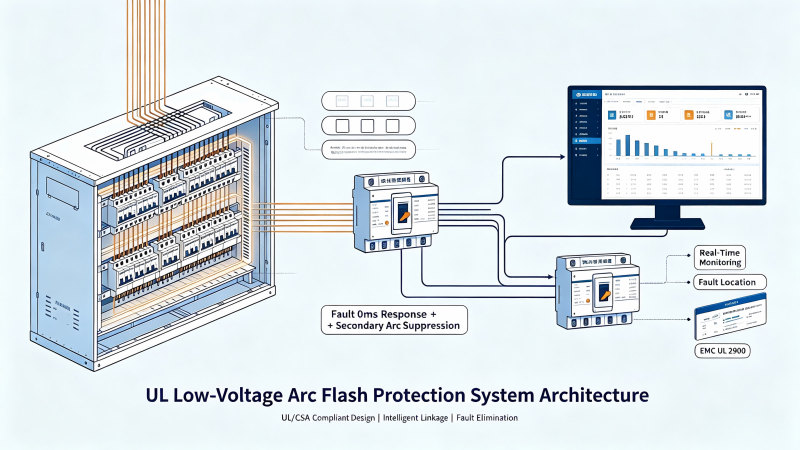
I. Hardware Design and Material Requirements
Hardware serves as the first physical line of defense against arc flash incidents, and the North American market imposes clear and stringent specifications in this regard.
Flame-Retardant Materials: All non-metallic components must pass UL94 V-0 flame-retardant testing. Metallic enclosures shall be fabricated from galvanized steel or stainless steel to ensure they do not propagate combustion or undergo deformation under the extreme temperatures of an arc flash event.
Structural Segregation: Compartmentalized layouts and rigid barrier-type protective structures are employed to isolate live parts and minimize arc flash propagation paths. Pressure relief channels are also incorporated to direct arc gases in a controlled manner, preventing impact injuries to operating personnel.
Detection Devices: Arc flash sensors must be equipped to monitor arc light signals within the enclosure in real time. These sensors shall exhibit immunity to electromagnetic interference, ensuring accurate arc fault identification in complex electromagnetic environments while preventing nuisance trips or missed detections.
II. Software and Intelligent Interlocking Requirements
Intelligent systems provide the "brain" for arc flash protection, and North American standards explicitly mandate control logic, cybersecurity, and data traceability.
High-Speed Response Logic: Arc flash protection devices shall incorporate millisecond-level fault recognition and actuation logic. Upon detection of an arc fault, the system shall prioritize tripping the circuit breaker while simultaneously interlocking to block erroneous operation circuits, thereby preventing secondary faults or human-induced escalation.
Cybersecurity Assurance: Intelligent arc flash protection systems must comply with UL 2900-2-1 (Industrial IoT Security) and support firmware encryption and access control to prevent cyberattacks that could compromise protection functionality.
Data Traceability: Devices are required to record critical data, including fault time, fault type, and operational response sequences, to facilitate post-event fault analysis and accountability, while meeting North American regulatory compliance requirements for equipment operation and maintenance.
III. Test and Verification Requirements
Products must undergo a series of rigorous tests prior to shipment to validate their withstand capability and reliability under arc fault conditions.
Arc Withstand Testing: Equipment must pass corresponding arc tests, such as CSA 85 kA/0.5 s testing or UL IEEE 1584 arc energy testing, to verify structural integrity and protective effectiveness under extreme fault conditions.
Temperature Rise and Mechanical Testing: Busbar temperature rise shall be ≤50 K to ensure controlled thermal performance after an arc fault. Cabinet load-bearing capacity shall be ≥2000 kg, verified through mechanical strength tests to guarantee structural stability.
Electromagnetic Compatibility (EMC) Testing: Intelligent arc flash protection devices must pass EMC testing in accordance with UL 1699 (revised edition) requirements, addressing electromagnetic interference challenges arising from high-frequency sampling and wireless modules in smart devices.
IV. Safety Control Requirements for Maintenance Operations (High-Risk Scenarios Requiring Special Attention)
Statistics indicate that maintenance activities are a leading trigger of arc flash incidents. The North American market imposes mandatory requirements for operational procedures, personal protective equipment, and device interlocking.
Safety Process Controls for Maintenance Operations
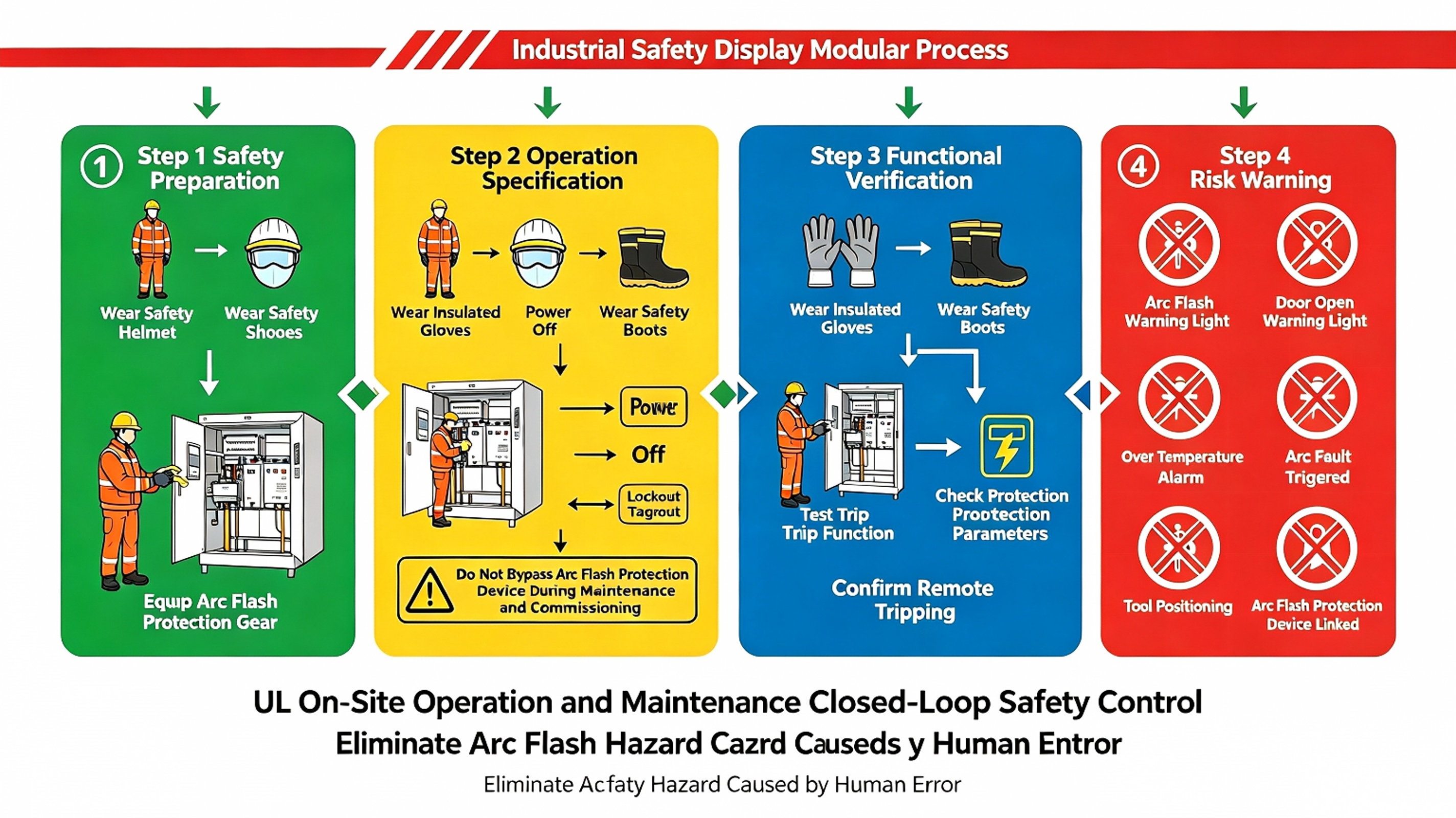
Prior to maintenance, strict adherence to the lockout-tagout (LOTO) procedure—including de-energization, voltage verification, and grounding—is mandatory; live working is strictly prohibited. If live maintenance is absolutely necessary, a special safety plan must be developed and approved, with the arc flash protection device remaining fully operational throughout the process to continuously monitor risk conditions in the work area.
During maintenance, contact with live components and erroneous switch operations are strictly forbidden. Tools must be used properly to prevent mechanical damage to busbars and insulating parts, eliminating human-induced triggers at their source.
Mandatory Personal Protective Equipment (PPE) Requirements
Maintenance personnel must be equipped with protective gear compliant with North American standards, including flame-resistant clothing, arc-rated face shields, insulating gloves, and impact-resistant insulating footwear. The PPE protection level shall match the potential arc flash energy that the equipment may produce.
In high-risk sectors such as petrochemical facilities and data centers, additional specialized PPE such as blast-resistant face shields and anti-static clothing is required, and the arc flash protection system shall be interlocked with explosion-proof structural features.
Interlocking and Real-Time Monitoring of Arc Flash Protection Devices
Arc flash protection devices shall not be deactivated or bypassed during maintenance. If temporary parameter adjustments are necessary, they must be authorized and documented, with original settings restored immediately upon completion of maintenance.
Prior to maintenance, interlocking logic between the protection device, circuit breakers, and contactors shall be tested to ensure millisecond-level trip initiation upon fault occurrence. Breaker failure protection functions shall also be verified to prevent fault escalation caused by breaker malfunction.
From certification compliance to technical implementation, from test verification to operational maintenance control, the North American market has established a comprehensive, closed-loop regulatory framework for arc flash protection in low-voltage switchgear. The core objective remains consistent: ensuring personnel safety, equipment stability, and system continuity through rapid arc fault mitigation and robust safety controls.
For enterprises aiming to enter the North American market, precisely aligning with UL/CSA certification requirements, staying current with regulatory developments, and optimizing technical solutions for specific industry applications are all indispensable. Only by translating compliance mandates into tangible product excellence can manufacturers secure a competitive advantage in the increasingly competitive international landscape.