Virtual Power Plant: A Smart Platform Connecting the Energy Future (Part 1)
2026-07-30
What is a Virtual Power Plant?
When people hear the word "power plant," they often picture towering smokestacks, massive cooling towers, and the thunderous roar of generating units. However, against the backdrop of China's "dual carbon" goals and the accelerated development of a new-type power system, a new kind of power plant—one without physical facilities, yet capable of aggregating and dispatching energy resources—is rapidly evolving. This is the virtual power plant (VPP).
A virtual power plant is not a physical generation facility in the traditional sense. Rather, it is an intelligent energy management system built on technologies such as the Internet of Things (IoT), big data, artificial intelligence algorithms, and cloud platforms. In essence, the core function of a VPP is to connect, manage, and dispatch distributed energy resources across cities in a unified manner, transforming scattered assets into a coordinated whole—"many grains of sand gathered into a tower."
In modern cities, distributed rooftop photovoltaics, commercial and industrial energy storage systems, electric vehicle (EV) charging stations, central air-conditioning systems, and industrial loads are abundant. Yet these resources are often small in capacity and geographically dispersed, making it difficult for them to participate directly in grid dispatch or power market trading. The VPP acts as a digital commander, integrating these decentralized resources through communication networks and intelligent algorithms into an energy aggregation that is observable, predictable, controllable, and tradable.
From the grid's perspective, a VPP can operate much like a conventional power plant: during periods of power shortages, it can release electricity through storage discharge and load regulation; when renewable generation is abundant or electricity prices are low, it can absorb excess power to enable flexible consumption. In this way, the VPP serves as a critical link connecting generation, grid, load, and storage.
The Three Core Capabilities of a Virtual Power Plant
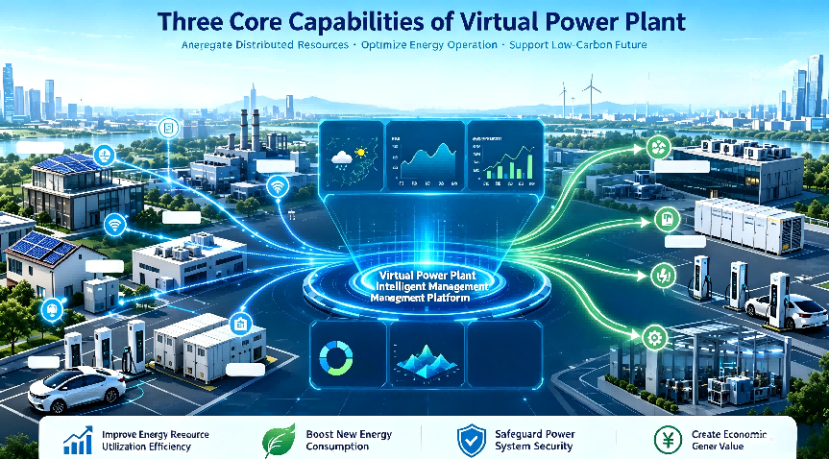
To efficiently integrate a large number of distributed energy nodes, a VPP relies on three key capabilities: comprehensive perception, smart decision-making, and precise coordination.

Comprehensive Perception: Making Energy Status Visible
A VPP first leverages IoT devices, intelligent gateways, and edge computing technologies to collect real-time data from various energy assets, including battery state of charge, charge/discharge power, operating status, EV charger availability, and building and factory load profiles.
This real-time data ingestion makes previously dispersed and invisible energy resources transparent and controllable, laying the foundation for subsequent dispatch and optimization.
Smart Decision-Making: Enabling Accurate Energy Scheduling
At the heart of a VPP lies its intelligent algorithm suite. The system must synthesize multi-dimensional information—weather forecasts, photovoltaic generation predictions, historical load patterns, price signals, and consumer behavior—to rapidly determine when to charge, when to discharge, when to curtail load, and when to participate in market transactions.
Through artificial intelligence and big data analytics, the VPP can generate optimal dispatch strategies in near real-time, achieving highly efficient allocation of energy resources.
Precise Coordination: Enabling the Flow of Energy Resources
A VPP does more than collect data—it enables bidirectional control. When the grid requires load reduction, the system can remotely adjust central air-conditioning setpoints, direct storage systems to discharge, and instruct EV chargers to defer charging. Conversely, when renewable generation is plentiful, it can coordinate storage devices and EV charging to enhance green power absorption.
This precise coordination capability gives the VPP tangible value in grid regulation and market participation.
The Technological Future of Virtual Power Plants

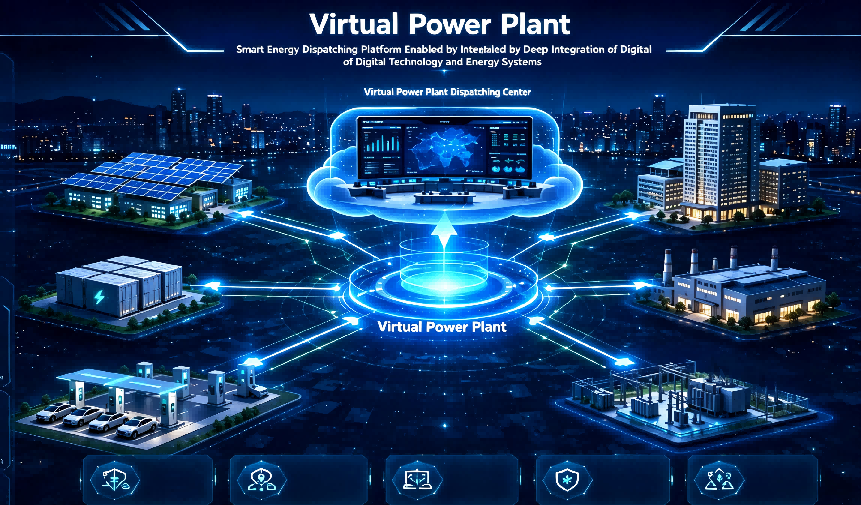
The virtual power plant represents a significant milestone in the deep integration of digital technologies and energy systems. By intelligently integrating distributed photovoltaics, storage, charging infrastructure, building loads, and industrial energy assets, it transforms fragmented energy nodes into stable, flexible, and dispatchable power resources.
Looking ahead, VPPs will play an increasingly vital role in the development of new-type power systems, the transition of energy structures, and the pursuit of green and low-carbon development. Leveraging integrated hardware-software capabilities and smart energy platforms, VPPs will continue to bridge generation, grid, load, and storage, driving energy management from coarse-grained to refined, and from isolated operations to coordinated optimization.
This "invisible" energy revolution is quietly reshaping the way we power our future.