The Dawn of Sodium-Ion Batteries
2026-07-24
I. Why Do We Need Sodium-Ion Batteries?
Lithium-ion batteries deliver outstanding performance, yet they face a critical bottleneck: scarce lithium resources. China’s external reliance on lithium resources exceeds 70%, accompanied by extreme price volatility. The price of lithium carbonate once surged above 600,000 RMB per ton before plummeting to single-digit figures, creating massive uncertainty for energy storage investors.
Core Advantages of Sodium Resources
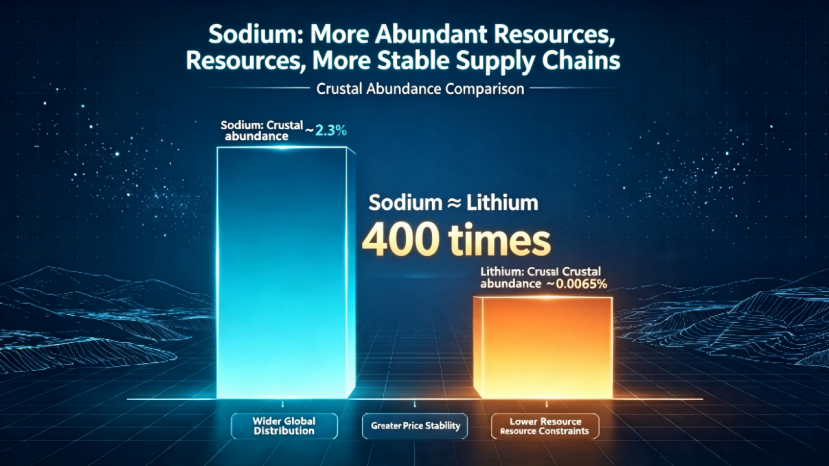
Abundant Reserves: Sodium reserves in the Earth’s crust are over 400 times those of lithium, with evenly distributed global deposits accessible for extraction worldwide.
Cost Competitiveness: Raw material costs are 30%–40% lower than lithium-ion batteries, with far greater long-term price stability.
Secure Supply Chains: Domestic sodium resources are highly self-sufficient in China, effectively mitigating supply chain risks tied to lithium-ion batteries.
Unique Strengths of Sodium-Ion Batteries for Energy Storage
Ultra-Long Cycle Life: Top-tier industrial products achieve over 15,000 cycles at 25°C, with an ideal system service life of 20–25 years — far exceeding the 15-year design lifespan of mainstream lithium iron phosphate energy storage systems.
Wide Temperature Adaptability: Capacity retention remains above 92% at -20°C, and discharge is functional even at -40°C, eliminating performance failures in frigid northern regions.
Inherent Safety: The surface temperature during thermal runaway is roughly 60°C lower than lithium-ion batteries, gas generation drops by 35%, and the critical state of charge (SOC) threshold for overcharging is significantly elevated.
II. 2026: Three Major Drivers Propel the Sodium-Ion Battery Industry Forward
Driver One: Technological Maturity
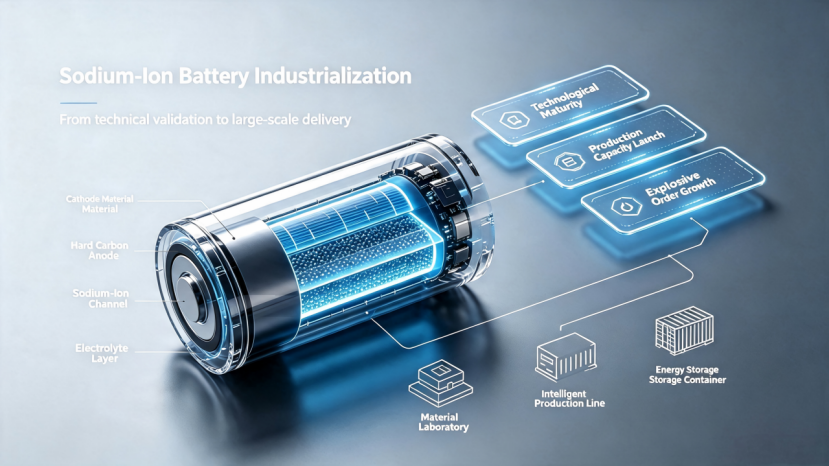
Cathode Materials: The polyanionic route (composite sodium iron phosphate, NFPP) has achieved groundbreaking breakthroughs. Cells deliver more than 15,000 cycles, electrode compaction density keeps rising, and manufacturing costs have fallen by 30%–50%.
Anode Materials: The industry has broken reliance on natural raw materials and entered mass production engineering. Two hard carbon technical routes run in parallel:
l Resin-based hard carbon: High performance and consistency, ideal for high-end power batteries and high-frequency energy storage applications.
l Coal-based hard carbon: High material yield and ultra-low costs, tailored for large-scale energy storage. Industry projections place hard carbon anode costs at 35,000–40,000 RMB per ton by 2026, with a long-term target below 25,000 RMB per ton.
Driver Two: Mass Production Capacity Launches
Leading enterprises have planned gigawatt-hour (GWh)-scale dedicated sodium-ion battery production lines, with commercial manufacturing facilities already operational, supported by matching ten-thousand-ton hard carbon anode production capacity. Sodium-ion batteries are no longer conceptual prototypes but mass-producible, deliverable commercial products.
Driver Three: Explosive Order Growth
The world’s largest sodium-ion energy storage contract (60 GWh over three years) marks a pivotal industrial inflection point, shifting the sector from "zero-to-one" technological validation to "one-to-N" large-scale expansion. Multiple hundred-megawatt sodium-ion energy storage power stations have been commissioned domestically, while GWh-level sodium storage tenders have rolled out across overseas markets — fully completing commercial verification for sodium-ion energy storage.
III. Sodium vs. Lithium-Ion Batteries: Complementary, Not Competitive
A widespread misconception claims sodium-ion batteries will replace lithium-ion batteries. Industry consensus confirms the two technologies operate in tandem as complementary solutions.
| Metric | Lithium-Ion Batteries | Sodium-Ion Batteries |
| Energy Density | High (200–300 Wh/kg) | Medium (100–175 Wh/kg) |
| Cycle Life | 3,000–6,000 cycles | 15,000+ cycles |
| Low-Temperature Performance | Poor | Excellent (Operable at -40°C) |
| Safety Level | Moderate | Superior |
| Raw Material Costs | High (Dependent on imported lithium ore) | Low (Globally abundant sodium resources) |
| Optimal Application Scenarios | Electric vehicles, consumer electronics | Large-scale stationary energy storage |
The "unified cabinet dual-cell" platform design has become an industry trend: identical cabinet structures, interfaces, and communication protocols support free switching between lithium and sodium cells. Customers no longer need to commit to a single technology route, choosing whichever delivers better economic value.
IV. Core Application Scenarios for Sodium-Ion Batteries
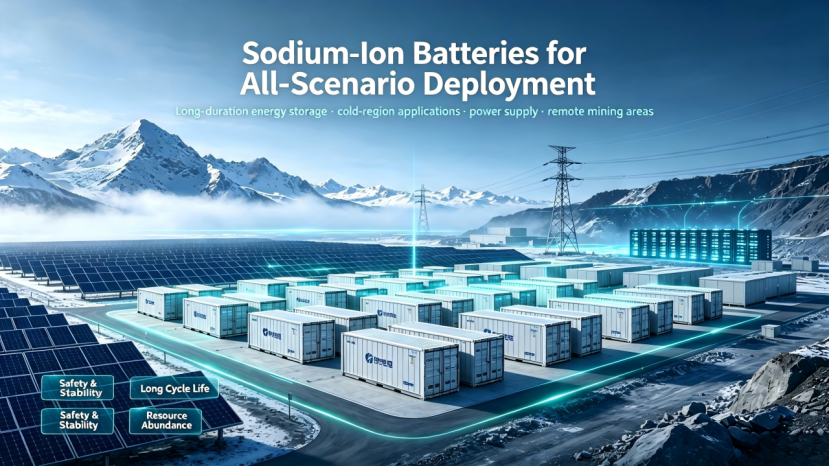
Large Independent Energy Storage Power Stations: 15,000-cycle lifespan and 20–25-year service life perfectly match the long-term operational requirements of storage facilities.
Energy Storage in Frigid Regions: Maintains over 92% capacity at -20°C without heating systems, slashing investment in thermal insulation equipment.
Data Center Power Supply for AI & Computing Clusters: Inherent safety meets strict reliability and safety standards for AI computing infrastructure.
Long-Duration Energy Storage: Flexible configurations for 4–6+ hour discharge durations, supporting peak regulation for wind and solar mega-bases.
Remote Mining & Oilfield Operations: Wide temperature tolerance and superior safety adapt to harsh, isolated operating environments.
V. Commercial Outlook & Cost Projections
Cost Decline Trajectory
l Current sodium-ion cell cost stands at approximately 0.45 RMB/Wh, narrowing the gap to lithium iron phosphate cells to roughly 0.1 RMB/Wh.
l Multiple institutions forecast sodium-ion battery costs will match lithium iron phosphate by the end of 2026.
l Post-2027, system-level costs for sodium-ion batteries are expected to undercut lithium iron phosphate systems.
Four Key Pathways to Lower Costs
Raw Material Optimization: Unconstrained sodium supply chains, plus low-cost aluminum foil as a substitute for copper foil used in lithium-ion batteries.
Production Scale Effects: Massive gigawatt-hour capacity expansion reduces depreciation, labor, and energy costs as facility utilization rises.
Manufacturing Process Iteration: Multi-round process upgrades have pushed production yield to commercial-grade standards.
Complete Industrial Chain Support: Synchronized capacity expansion across upstream material suppliers, cell manufacturers, and system integrators.
Market Forecast
Global sodium-ion battery shipments for energy storage will reach 580 GWh by 2030, with the sector recording a compound annual growth rate (CAGR) exceeding 150%.
VI. Core Conclusions
l Sodium-ion batteries complement — rather than replace — lithium-ion batteries. The two technologies will develop in parallel to build a new generation of energy storage infrastructure.
l Sodium-ion batteries will carve out distinct competitive advantages in long-duration storage, cold-region energy storage, and computing center power supply niches.
l Industry focus has shifted from technological breakthroughs to order fulfillment and capacity delivery.
l The era of sodium-ion batteries has arrived, and the technology will emerge as a core driver of energy transition during China’s 15th Five-Year Plan period.