Comparison of Low-Voltage Switchgear Standards: UL 891 vs. GB/T 7251.2
2026-09-03
Significant differences exist between the U.S. UL 891 standard and China's GB/T 7251.2 standard in terms of formulating bodies, scopes of application, technical requirements, and certification systems. A comparative analysis is provided below across multiple dimensions:
1. Formulating Bodies and Scopes of Application
UL 891 Standard
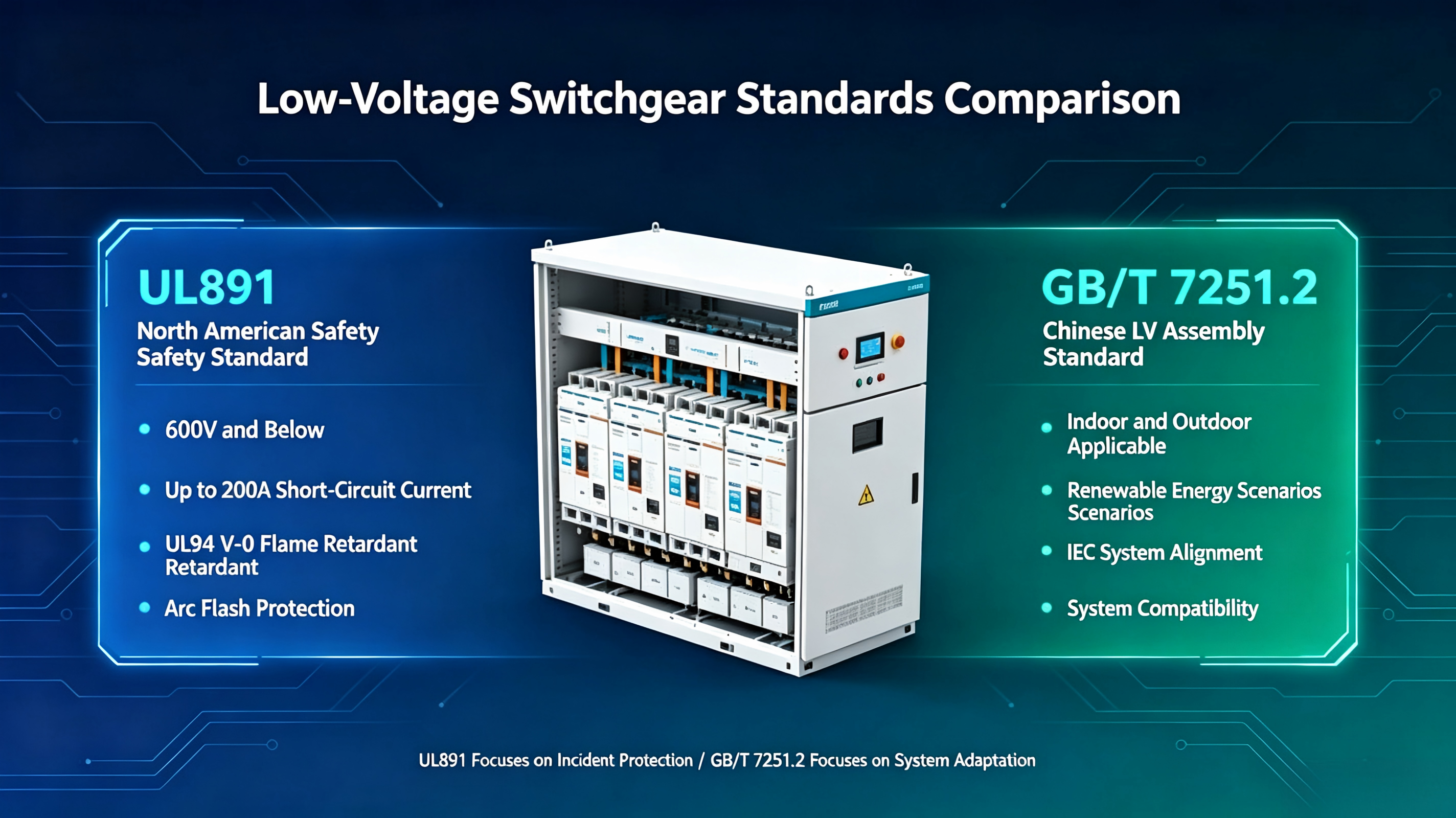
Formulating Body: Developed by Underwriters Laboratories (UL) in the United States. It is a safety standard for enclosed switchboards rated at 1000 V and below for the North American market, widely adopted by the U.S. National Electrical Code (NEC) and other regulations, and carries a regional market-access attribute.
Scope of Application: Primarily applicable to the United States, Canada, and other North American regions. It serves as a mandatory certification basis for products entering the North American market, with a core focus on comprehensive control of equipment safety performance.
GB/T 7251.2 Standard
Formulating Body: Issued by the State Administration for Market Regulation and the Standardization Administration of China, proposed by the China Electrical Equipment Industry Association, and under the jurisdiction of the National Technical Committee on Low-Voltage Switchgear and Controlgear Assemblies of Standardization Administration of China. It is a Chinese recommended national standard. The current version, GB/T 7251.2-2023, was issued on August 6, 2023, and implemented on March 1, 2024, superseding GB/T 7251.12-2013. It is identical to IEC 61439-2:2020, aligning its technical content with international standards.
Scope of Application: Applicable to low-voltage switchgear and controlgear assemblies within China, covering various scenarios such as indoor, outdoor, fixed, and movable installations. Other parts of the GB/T 7251 series provide supplementary requirements for specific applications like marinas, camping sites, and electric vehicle charging stations. The standard's technical content is identical to IEC standards, offering international compatibility.
2. Core Safety Performance Indicators
UL 891 Standard
Short-Circuit Withstand Capability: Requires the ability to withstand fault currents up to 200 kA, ensuring that the enclosure does not rupture, doors do not spring open, and arc flashes are not expelled, emphasizing physical protection under extreme fault conditions.
Temperature Rise Control: Under full-load operation, temperature rises at critical components such as busbars, connection points, and circuit breaker terminals must be strictly controlled within limits to prevent insulation degradation due to overheating and ensure long-term operational reliability.
Arc Flash Protection: Employs an enclosed structure with no exposed live parts on the front face. Live parts are isolated via barriers and protective enclosures, complemented by fast fault-interruption devices to clear fault currents, prioritizing operator safety.
Material Flammability: All non-metallic components must pass UL 94 V-0 flammability rating, requiring self-extinguishment and no dripping upon ignition, meeting North America's stringent fire safety requirements.
GB/T 7251.2 Standard
Short-Circuit Withstand Capability: Specifies quantified ratings such as rated short-time withstand current (Icw), rated peak withstand current (Ipk), and rated conditional short-circuit current (Icc), which must be verified through testing or equivalent methods.
Temperature Rise Control: Defines clear temperature-rise limits for critical parts such as busbars, connection points, and terminals, which can be verified by test, comparison with a reference design, or calculation.
Arc Flash Protection: Does not mandate quantified internal arc fault indicators. Personnel protection under internal arcing conditions may be assessed with reference to IEC/TR 61641, with arc risks mitigated through proper structural design.
Standard System: Builds a comprehensive safety system by referencing foundational standards such as IEC 61140 (protection against electric shock) and IEC 62262 (IK code), emphasizing coordinated compatibility with power generation, transmission, and distribution systems.
3. Certification Systems and Compliance Requirements
UL 891 Standard
Certification Nature: Legally a voluntary certification, but because the U.S. National Electrical Code (NEC) and local Authorities Having Jurisdiction (AHJ) generally require products to obtain NRTL listing, it effectively constitutes a de facto market-access barrier. Products without such listing find it difficult to enter the local market.
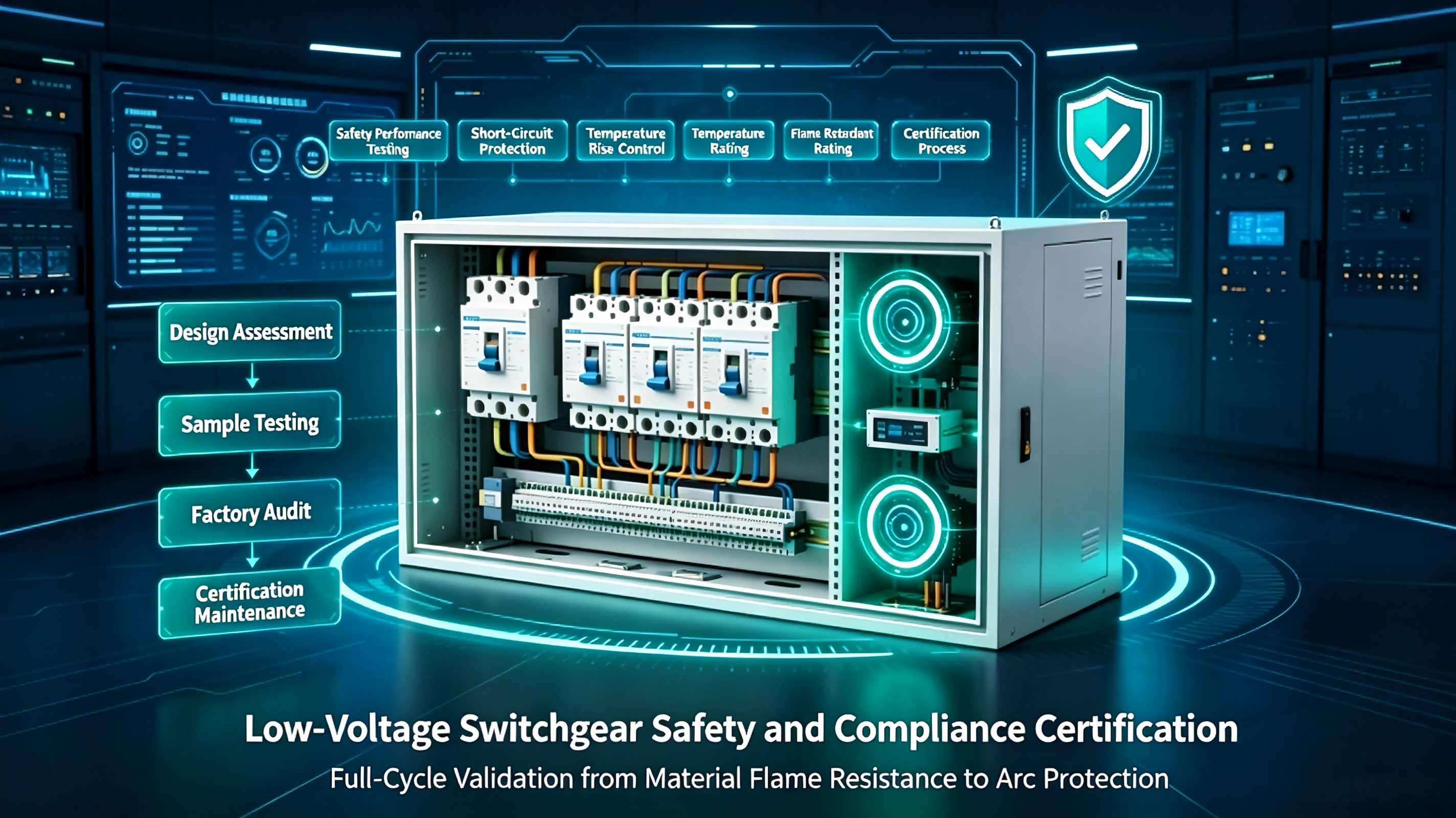
Certification Process: The process is rigorous and complex, comprising four major stages: design evaluation, sample testing, initial production inspection (IPI), and post-certification follow-up services. The typical certification cycle is 6 to 12 months, with strict control over product design, manufacturing processes, and quality management.
GB/T 7251.2 Standard
Certification Nature: This is a Chinese recommended national standard, and adoption by enterprises is voluntary. However, low-voltage switchgear assemblies are included in the China Compulsory Certification (CCC) catalog. Products entering the domestic market must obtain CCC certification, and GB/T 7251.2 is one of the core technical standards referenced for such certification.
Certification Process: There is no unified, dedicated certification program. Compliance is primarily verified through type testing conducted by third-party testing bodies in accordance with the standard. The process is relatively flexible with a shorter cycle, focusing more on product adaptability to the domestic industrial ecosystem.
4. Standard Positioning and Application Purposes
UL 891 Standard
Positioning: Centered on risk mitigation, from an insurer's perspective, focusing on equipment safety under both normal and fault conditions to reduce safety incidents and insurance losses. It represents the baseline safety compliance requirement for the North American market.
Application Purpose: To ensure equipment safety performance, meet North American grid adaptation and market-access requirements, support applications with high power-continuity demands such as data centers and photovoltaic power stations, and drive equipment evolution toward higher density and intelligence.
GB/T 7251.2 Standard
Positioning: Centered on technical specifications and industrial coordination. While ensuring basic equipment safety and quality, it also accommodates domestic industrial development levels and market demands. By aligning with international standards, it strikes a balance between localization and internationalization.
Application Purpose: To regulate the design and manufacture of low-voltage switchgear assemblies, ensure compatibility with power systems and industrial equipment, promote standardized production, and provide technical support for emerging sectors such as photovoltaics, thereby facilitating industrial upgrading.
Summary
In summary, the differences between UL 891 and GB/T 7251.2 fundamentally reflect distinct regional market safety regulatory logics, grid characteristics, and industrial ecosystems. Enterprises targeting the North American market need to focus on meeting UL 891's quantitative performance requirements and completing the UL listing certification process, while those operating in the domestic Chinese market should rely on GB/T 7251.2 to achieve standardized production and system compatibility, while also maintaining alignment with international standards to lay the groundwork for global expansion.